Had issues getting SQL 4 CDS to open. I tried reinstalling the plugin and the app, and that didn’t work. Finally went to …\AppData\Roaming\MscrmTools\XrmToolBox\Settings and deleted a file there called “MarkMpn.Sql4Cds.xml”. That seemed to have allowed me back in. Looks like it’s a settings file for SQL 4 CDS. After closing XRMToolbox, the file is regenerated.
I’ve been experimenting with running AI models locally, exploring different ways to make AI more accessible without depending on cloud services or dedicated AI servers.
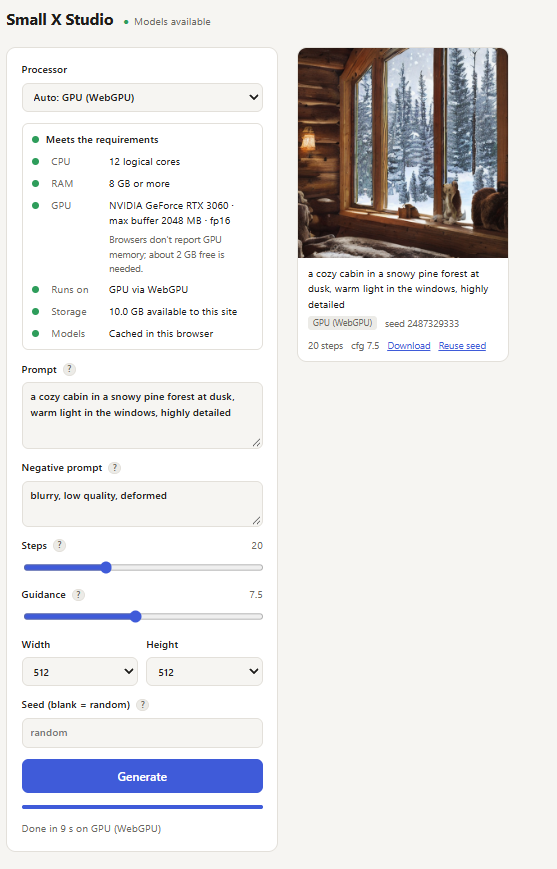
My latest project, Small X Studio, takes that experimentation in a different direction: running an AI image generation model directly inside a web browser.
I was inspired by this project https://webllm.mlc.ai/ which allows you to chat with an an agent locally.
Small X Studio is a self-hosted text-to-image application built using .NET 10, JavaScript, ONNX Runtime Web, and Stable Diffusion.
Unlike traditional AI image generation applications, where your browser sends requests to a back-end running the AI model, Small X Studio performs the actual image generation locally in the browser.
The .NET application serves the website and model files. Once the browser loads the model, the image generation process happens entirely on your device.
This means:
No cloud AI inference service is required.
No dedicated GPU server is needed.
Prompts and image generation remain local to the browser.
The application can take advantage of supported GPU hardware through WebGPU.
CPU-based execution is available as a fallback.
The entire application can be self-hosted using Docker.
A .NET 8 console app that reads a list of host:port entries, detects SSH services, and reports which authentication methods (password, public-key, keyboard-interactive) are allowed.
So far I have 2 apps for telling you your IP address.
One can be found here, https://yourip.sh. This is using GO and was forked from ifconfig.io. I wanted to learn GO so I forked that project and made modifications to it.
My other, older, app can be found here https://whatismyip.biz . This app is built in .NET, Blazor client side, running on a Linux server. This is totally custom built.
Both apps above a are docker images that I’ve created as well.
“This deprecation affects Azure DevOps Pipeline customers only if they are using Windows Server 2019 image in a Microsoft Hosted Agent. Please note that it does not impact customers using Windows 2019 in any other Agent (Self-hosted, MDP, VMSS). Refer the guidelines given below to find out the impacted pipelines in your organization. The detailed deprecation plan is outlined below.”
Key Dates:
• Deprecation Start Date: 1st June 2025 • Brownout period: 3rd June 2025 to 24th June 2025 • Full Removal Date: 30th June 2025
If using the classic UI Add task → search “Use .NET Core SDK (UseDotNet@2)”
Update the version to 9.0.203. The YAML should look like this.
This option did not work for me.
“Workaround that worked for me is setting a restore property BuildWithNetFrameworkHostedCompiler to true as documented here. This configures the build to use a matching version of the MSBuild with the latest SDK version installed. By default a version available with installed VS is being used, creating a mismatch.”
Converts a csv to a parquet file, per the delimiter, in .NET.
Nuget packages used
CsvHelper
Parquet.Net
This solution which is “as-is” converts a CSV file into a Parquet file. I created this because I could not find anything .NET based or Windows based that I could use to convert a file. ‘
The solution requires an input file, output file, error file, delimiter, and has header (true/false). If the files does not have a header than a fake header is created for the output file. The file is processed under the assumption that all the columns are strings. If an error occurs for a row then that row is written to the error file to be manually looked at. These errors occur sometimes if the row doesn’t match the columns already created by the first row of data.
The only other Windows app I could find was this https://superintendent.app but you need to load all the data then export it.
Further enhancements:
I wrote a batch function to process the file faster but the count appears to be off. Not sure why.
Performance enhancements. Currently reads and coverts file row by row; which is why I tried doing batches.
Better errors handling
Except arguments from the console
Read from file and do not load file into memory
Note
The current solution loads the entire file into memory so be sure you have enough RAM to process the file otherwise your system might become unstable. If your debugging then the memory footprint will be bigger than if you use release.
I had to write some code to ingest a CSV file, and this made it so much simpler. This nuget package is open source as well https://github.com/JoshClose/CsvHelper.
I deleted all the CSS from site.css and replaced it with mine of course but after that, I started receiving the following error “Getting error An unhandled exception has occurred. See browser dev tools for details. Reload”. It looks like this occurs because blazor needs at least 2 styles to display errors.
Before .NET 4.6 – TLS 1.1 is default and negotiations start down
.NET 4.6 – TLS 1.2 is default and negotiations start down
.NET 4.7 – the default value of this property is SecurityProtocolType.SystemDefault. This allows .NET Framework networking APIs based on SslStream (such as FTP, HTTP, and SMTP) to inherit the default security protocols from the operating system or from any custom configurations performed by a system administrator.
Built a .net core api using swagger, dnsclient.net, and rollbar. Have a look here https://github.com/xavier-hernandez/dnsclient-api .
Here is the README:
I created a YAML file built on OpenAPI 3.0 standards for my endpoints(paths) and models. I generated the stub code on https://editor.swagger.io/ then tweaked, fixed, and updated the code. Creating the stub code really gives a great head start.
I kept authentication simple, it’s using an API key sent in the header request. Currently the API key is hardcoded to “1” but maybe later I’ll use a database or something to store API keys. I might host this somewhere if it’s something I find interesting to host. Tie it maybe to a MySQL/MariaDB database.
I got this error today and was causing me a headache. I stopped all apps running in IIS Express, tried switching releases, etc. But seems like this is a bug in Visual Studio 2019.
Stop your application, close the solution, delete the .vs folder in the solution, open it back up and it should work.
All types and type members have an accessibility level, which controls whether they can be used from other code in your assembly or other assemblies. You can use the following access modifiers to specify the accessibility of a type or member when you declare it:
public
The type or member can be accessed by any other code in the same assembly or another assembly that references it.
private
The type or member can be accessed only by code in the same class or struct.
protected
The type or member can be accessed only by code in the same class or struct, or in a class that is derived from that class.
internal
The type or member can be accessed by any code in the same assembly, but not from another assembly.
protected internal
The type or member can be accessed by any code in the assembly in which it is declared, or from within a derived class in another assembly. Access from another assembly must take place within a class declaration that derives from the class in which the protected internal element is declared, and it must take place through an instance of the derived class type.